Run five checks before you call anyone: the outlet, the wall console lock button, the remote battery, the photo eyes, and the emergency release trolley. Opener repair in Minneapolis typically runs $100 to $250. A new opener installed is $315 to $452 for most homes.
If the motor hums or the lights come on but the door will not move, the problem is usually a broken spring, not the opener. Stop and read the spring section below first.
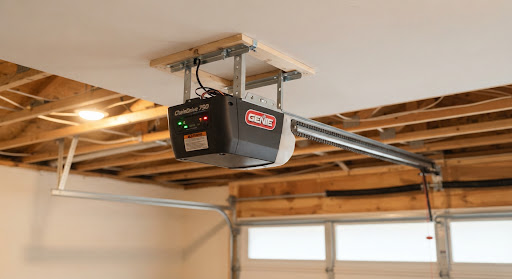
A ceiling mounted trolley opener. The motor head, the rail, the trolley and the photo eyes each fail in a different, recognizable way.
Most Twin Cities homes run a chain or belt drive trolley opener like this one. Most no-start problems trace to five causes.
The Five Minute Check, in Order
Work through these in order. Each one takes about a minute, and together they clear up most of the opener calls we get from Bloomington to Maple Grove without a truck ever leaving the shop.
Check the power
Look at the motor head. No lights at all means no power. Most openers plug into a ceiling outlet on a GFCI circuit, and a tripped GFCI in the garage or a nearby bathroom kills it. Press reset on the outlet and check the breaker panel.
Check the lock button
Every LiftMaster, Chamberlain and Genie wall console has a lock or vacation switch. Bumped once, it disables every remote and keypad while the wall button still works. Hold the lock button for a few seconds to clear it.
Swap the remote battery
If the wall button works but the remote does not, the remote battery is the suspect. Most take a CR2032 coin cell. Replace it, then reprogram the remote to the motor head if it still does nothing.
Look at the photo eyes
The two small sensors near the floor of each track must see each other. A steady light on both is good. A blinking eye means they are blocked, knocked out of alignment, or a wire is pinched. Wipe the lenses and gently square them up.
Check the trolley
If the motor runs but the door ignores it, someone pulled the red emergency release cord and the trolley is disconnected. Run the opener until the trolley clicks back into the carriage, or pull the cord toward the door to re-engage it.
We diagnose openers across the Twin Cities
A technician can usually tell you over the phone whether it sounds like the opener, the spring or the sensors, and you get a written price before any work starts.
What Each Symptom Usually Means, and What It Costs
After twenty minutes in a garage you learn that openers announce their problem by sound. Here is the translation table, with the typical Minneapolis price range for each fix. Every figure is a typical range, written quote first.
| Symptom | Most likely cause | The fix | Typical cost |
|---|---|---|---|
| Nothing at all, no lights | Tripped GFCI, dead outlet, failed logic board | Reset power, or replace the board | Free to check, $100 to $250 repair |
| Hums or strains, door stays down | Broken torsion spring, not the opener | Spring replacement | $143 to $333 per spring |
| Clicks and the lights flash | Blocked or misaligned photo eyes | Clean, realign, or rewire the sensors | Free DIY, $100 to $150 service |
| Grinds loudly, door barely moves | Stripped nylon drive gear | Gear and sprocket kit | $100 to $250 |
| Runs, then reverses before closing | Travel limit or force setting drift | Adjust limits and force, test balance | $100 to $150 |
| Works from the wall, not the remote | Remote battery, lost code, worn receiver | Battery, reprogram, or receiver | Free DIY to $150 |
Is It the Opener or the Door Itself?
The fastest way to separate the two: pull the red release cord with the door closed and lift the door by hand. A healthy door rises smoothly with one hand and stays put at waist height. If it does, the opener needs attention. If it is heavy, crooked or grinding, the opener was never the problem.
It is the opener
Door lifts easily by hand, but the motor will not run it. Think logic board, drive gear, capacitor, rail, trolley or receiver. Repairs run $100 to $250, and we service LiftMaster, Genie, Craftsman and Chamberlain units. If it predates 1993 it has no photo eyes and we recommend replacement.
It is the door
Door feels like dead weight, one side droops, or you see a gap in the spring coil. That is a spring, cable or track problem. Read our guide on what to do about a broken spring, and do not keep cycling the opener against it.
When Minnesota Cold Is the Real Culprit
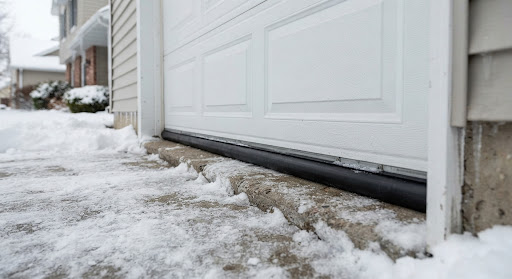
Every January we get a wave of opener calls that are really weather calls. Cold thickens the grease on the rail and in the gearbox, steel tracks and rollers contract and bind, and the force setting that closed the door fine in September now trips the safety reverse, so the door starts down and pops back up. On mornings after a thaw, meltwater freezes the bottom seal to the slab and the opener strains against a door glued to the concrete.
Before you condemn the opener in winter, check whether the door is refusing to close rather than refusing to run, and look at the bottom seal for ice. A fall annual tune-up with cold rated lubricant, a balance check and a force adjustment prevents most of this.
When to Repair the Opener and When to Replace It
A $150 gear kit on a seven year old belt drive is money well spent. The same repair on a fifteen year old builder grade chain drive usually is not, because the board, the capacitor and the rail are all the same age. Here is how we call it for homeowners from Plymouth to Woodbury.
A new opener installed typically runs $315 to $452 in the Twin Cities, with the full spread from $109 to $771 depending on the unit. Our belt vs chain vs wall-mount comparison walks through which drive earns its price, or contact us for a written quote on your door.
Opener Troubleshooting FAQ
David Gordon
Owner, Top Team Garage DoorDavid Gordon started Top Team Garage Door in 2017 and still spends his weeks on doors and openers around Minneapolis, St. Paul and the wider metro. These guides exist so a homeowner can recognize a fair price and a proper repair before calling anyone, us included.