A garage door that will not open in the cold usually has one of four problems: a bottom seal frozen to the slab, a snapped torsion spring, an opener fighting cold-thickened grease, or frosted photo eye sensors. In Minneapolis, the mechanical fixes typically run $150 to $370, and a frozen seal often costs nothing to free.
Run the five checks in section one before you call anyone. If you see a gap in the spring above the door, stop there. A broken spring is not a DIY job and the door can fall if you force it.
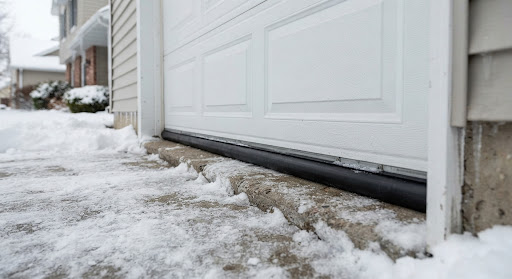
The rubber bottom seal traps meltwater against the slab on the first hard freeze, and by morning the whole door is glued down.
The bottom seal is the most common reason a Minnesota garage door will not budge on a subzero morning.
Run These Five Checks Before You Call Anyone
A good share of the cold-morning calls we take across the Twin Cities turn out to be something the homeowner could have cleared in five minutes. Work through this list in order. No ladder or tools required.
Check the wall console lock button
Most LiftMaster, Chamberlain and Genie wall consoles have a lock feature that disables every remote. Gloved hands hit it by accident all winter. If the console light blinks, hold the lock button for a few seconds and try again.
Swap the remote battery
Coin cell batteries lose a large share of their output in the cold, and a remote that worked in October can go quiet in January. Try the wall button first: if the wall button works and the remote does not, it is the battery.
Look at the photo eye sensors
The two small lenses near the floor must see each other. Frost, road salt film or a snow shovel leaning against the track will stop the door. Wipe both lenses dry and confirm both indicator lights are on steady.
Confirm the opener has power
Garage outlets are often on a GFCI circuit that trips in damp cold weather. If the opener light is dead, press reset on the outlet and check the breaker panel before assuming the motor failed.
Look up at the spring
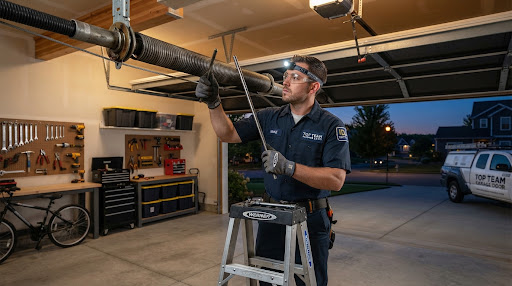
With the door closed, look at the torsion spring on the shaft above the opening. A clean 2-inch gap in the coil means it snapped, which is exactly what cold does to tired spring steel. Stop here and call a pro.
What the Cold Actually Does to a Garage Door
A garage door is a few hundred pounds of steel, rubber and wound spring wire, and every one of those materials behaves worse below zero. Here is the mechanical reality behind the morning your door refused to move.
Spring steel turns brittle
Cold makes spring steel less ductile. A torsion spring that is already near the end of its cycle rating tends to let go on the first truly cold morning of the season, often with a bang you hear inside the house.
The bottom seal freezes down
Meltwater from the car drips to the slab, wicks under the rubber bottom seal, and refreezes overnight. The opener pulls, the door stays glued, and the force limit shuts the motor down to protect itself.
Grease thickens, metal shrinks
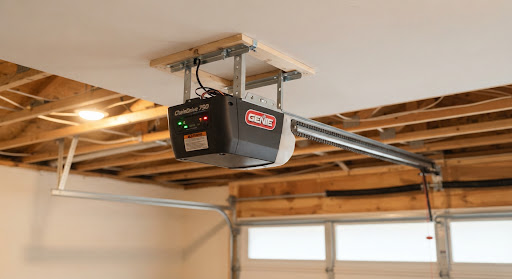
Old lithium grease in the opener rail and on the rollers stiffens like taffy in the cold. Steel tracks and rollers also contract slightly, so a door that was marginal in September starts binding in January.
Photo eyes fog and frost
Temperature swings put condensation and frost on the sensor lenses. The opener reads that as an obstruction and refuses to run until the beam is clear.
None of this is a defect. It is what happens to any garage door in Minneapolis that goes into winter without a fall tune-up.
What Each Cold-Weather Fix Costs in Minneapolis
These are the typical ranges we see across Minneapolis and the metro for the common cold-weather failures. Every one is a typical range, written quote first: you should know the number before any work starts.
| Problem | Usual fix | Typical Minneapolis price | DIY or pro |
|---|---|---|---|
| Door frozen to the slab | Break the ice bond, dry the seal | Often $0 yourself | DIY |
| Torn or flattened bottom seal | New bottom seal | $85 to $200 | Either |
| Broken torsion spring | Spring replacement | $143 to $333 each | Pro only |
| Opener straining or clicking | Opener repair | $100 to $250 | Pro |
| Stiff rollers, dry hinges, binding track | Tune-up and lubrication | $75 to $150 | Either |
| Frayed lift cables | Cable replacement | $150 to $300 | Pro only |
Door down and the car inside?
We answer 7 AM to 11 PM every day, tell you the scheduling window when you call, and quote the full price in writing before any work starts.
Cold-Weather Fixes That Are Safe to Do Yourself
Plenty of winter door problems are fair game for a homeowner. These are the ones we are comfortable telling a neighbor in Richfield or St. Paul to handle on their own.
When to Stop and Call a Professional
Three winter failures should end the DIY session immediately: a broken spring, a frayed or jumped cable, and a door that has come off its track. All three involve hardware under load. The spring does about all of the lifting on a garage door; the opener just guides it. Forcing a 250-pound door with a dead spring can strip the opener gear and bend the top panel, turning a modest repair into a much bigger one.
If you are looking at any of those three, our our emergency repair service crew covers Minneapolis and the metro 7 AM to 11 PM daily, and spring repair is the single most common call we run all winter. We work on LiftMaster, Chamberlain, Genie, Clopay and Amarr hardware every week, from alley garages in Northeast Minneapolis to three-car garages in Plymouth. Tell us what you found in your five checks and book a visit; it usually shortens the appointment.
Cold-Weather Garage Door FAQ
David Gordon
Owner, Top Team Garage DoorDavid Gordon founded Top Team Garage Door in 2017 and has spent every Minnesota winter since repairing springs, openers and frozen doors across Minneapolis, St. Paul and the surrounding metro. The company is licensed by the City of Minneapolis, bonded and insured, and quotes every job in writing before work starts.